
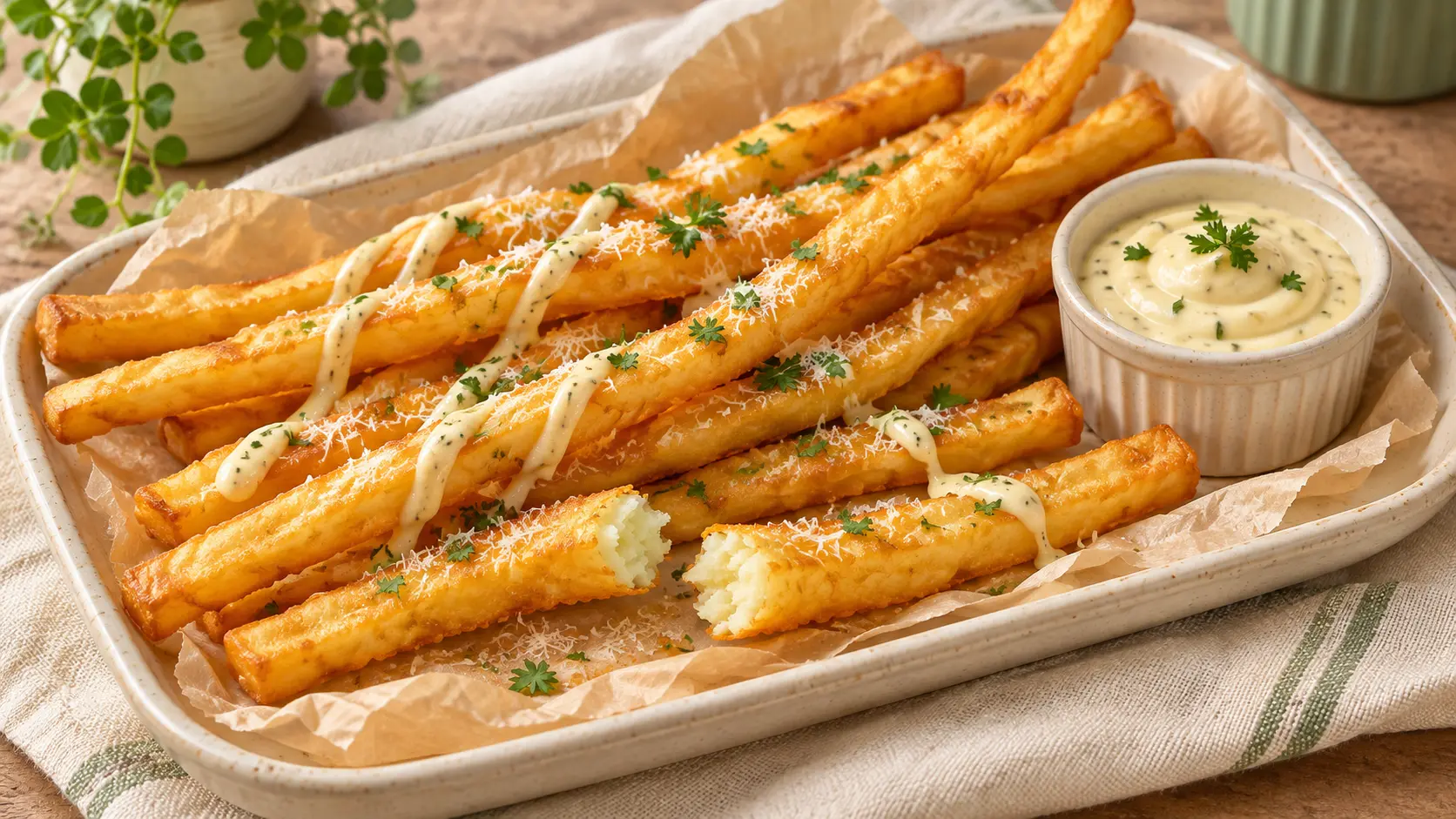
Japanese-style long fries are made from a smooth mashed-potato dough, cut into extra-long strips and fried until golden. This home version uses cornstarch and simple seasonings for crisp edges and a soft potato center. Serve with optional garlic mayo for dipping.
At a glance: Estimated 4 snack servings · 20 minutes prep · 40 minutes cooking · 45 minutes chilling · about 1 hour 45 minutes total.
What makes these different from regular fries?
These are shaped fries, not long pieces cut directly from a raw potato. Cooking and mashing the potatoes first lets you form a dough that can be rolled and sliced. The starch helps the strips hold together while frying. A little chew inside is normal; do not expect the same center as a conventional French fry.
The supplied Pin shows long golden fries with a pale drizzle and green garnish, but it does not reveal quantities or confirm the sauce. This is a photo-inspired, independently written home variation, not a reconstruction of the exact video recipe. It has not been kitchen-tested by Recipes Cooker; times and yield are estimates.
Ingredients that help the fries hold their shape
- Russet potatoes: Their starchy mash is a practical choice for this dough. Weigh after peeling, before cooking, so potato size does not determine the batch.
- Cornstarch: This recipe is written for cornstarch, not wheat flour or cornmeal. In some countries it is labeled cornflour; check that the package means pure corn starch. Potato starch is used in other versions, but do not assume identical quantities give identical texture.
- Garlic powder and paprika: Dry seasonings avoid adding chopped, wet ingredients to a fragile dough.
- Neutral oil: Use oil intended for frying, such as canola or vegetable oil. The listed quantity fills the pot; it is not a measure of how much ends up in a serving.
- Optional toppings: Store-bought mayo, parsley, and Parmesan give a serving style similar to the picture. The image alone cannot confirm that these are its original toppings.
The texture check matters more than extra starch
A strip should lift without stretching apart. If the mash is wet, dry it before mixing rather than trying to rescue it with a large amount of starch. If the dough crumbles, add only a teaspoon of water at a time. Refrigerate until firm and handle long strips with support underneath them.
Roll, chill, and cut evenly
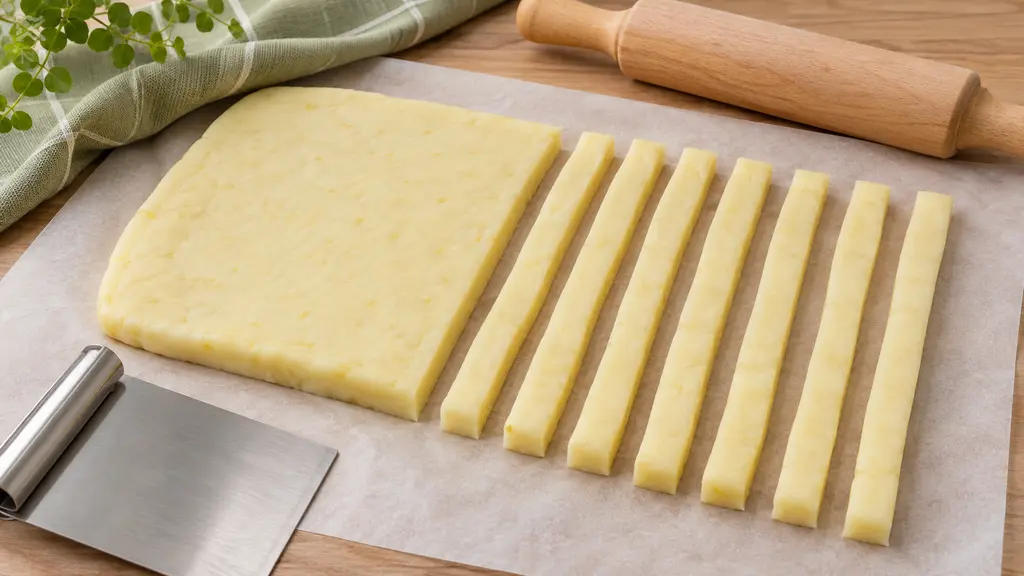
Aim for an even 3/8-inch thickness. Thin patches can snap while thick ends take longer to crisp. A bench scraper or wide spatula helps move the slab and lift the cut strips. Shorter fries are easier to manage, so cut them to fit the cookware you already have rather than choosing an oversized pot just for the length.
This method uses the refrigerator, not the freezer. Keep the dough covered while chilling and use dry utensils at the stove. Do not lower parchment paper, packaging, loose ice, or wet tools into the frying oil.
Japanese-Style Long Fries with Garlic Mayo
Golden mashed-potato fries with a soft center and an optional tangy garlic dip. Estimated yield: about 24 fries, depending on thickness and length; 4 snack servings.
Prep: 20 minutes · Cook: 40 minutes, including boiling and batch frying · Chill: about 45 minutes · Total: about 1 hour 45 minutes.
Equipment
Kitchen scale, saucepan, colander, potato ricer or masher, parchment, rolling pin, tray, knife, wide deep heavy pot, deep-fry thermometer, dry slotted spatula, and a wire rack over a tray.
For the fries
- 500 g peeled russet potatoes (about 1 pound 2 ounces), cut into even 1-inch chunks
- 60 g cornstarch (about 1/2 cup; weighing is more consistent), plus 1–2 teaspoons only if needed
- 1/2 teaspoon kosher salt, plus a small pinch after frying if desired
- 1/2 teaspoon garlic powder
- 1/2 teaspoon paprika
- 1/4 teaspoon black pepper
- Neutral frying oil, such as canola or vegetable oil, as needed for about 1 inch of depth; roughly 4–6 cups depending on your pot, not all absorbed
- Optional garnish: 1 tablespoon chopped parsley and 1 tablespoon finely grated Parmesan
Optional garlic mayo
- 1/4 cup store-bought mayonnaise
- 1 teaspoon lemon juice
- 1/4 teaspoon garlic powder
- 1–2 teaspoons water, only if needed for drizzling
Instructions
- Cook the potatoes. Put the peeled potato chunks in a saucepan, cover with cold water, and bring to a boil. Reduce to a steady simmer and cook until a fork slides through easily, about 15–20 minutes after the water starts boiling. Drain completely.
- Dry and mash. Return the potatoes to the empty saucepan over low heat for 1–2 minutes, stirring to release surface moisture. Remove from the heat. Mash smoothly with a ricer or hand masher; do not use a blender. Let the mash stop steaming heavily before handling.
- Make the dough. Fold in the measured cornstarch, salt, garlic powder, paprika, and pepper. Press together gently until the mixture holds its shape. If it remains wet and sticky, add another teaspoon of cornstarch, then reassess; avoid adding large handfuls. If genuinely dry and crumbly, work in water 1 teaspoon at a time, only until it holds together.
- Shape and refrigerate. Roll between two sheets of parchment to about 3/8 inch (1 cm) thick. Slide onto a tray, cover, and refrigerate for about 45 minutes, or until firm enough to lift. Cut into strips about 3/8 inch wide and 6–7 inches long. Shorten them if needed to fit your pot comfortably. Keep waiting strips refrigerated.
- Mix the optional dip. Stir the mayonnaise, lemon juice, and garlic powder together. Add water a teaspoon at a time only if you want a drizzle. Cover and refrigerate until serving.
- Heat the oil safely. With the burner off, pour about 1 inch of oil into a dry, wide, deep, heavy pot. Never fill the pot more than one-third full. Heat gradually to 350°F (175°C), using a deep-fry thermometer. Have a dry metal lid nearby and keep water away from the oil.
- Fry a test piece, then small batches. Use a dry, wide slotted spatula to lower a short test strip into the oil close to its surface. If it holds together, add 3–4 full strips without crowding. Fry for about 3–5 minutes per batch, gently turning once the underside has set, until golden and crisp. Keep the oil near 350°F and let it return to temperature between batches. If the test piece breaks, stop and check dough firmness and oil temperature before adding more.
- Drain and serve. Lift onto a wire rack set over a tray. Add a small pinch of salt if needed. Serve promptly with the dip on the side, or add a light drizzle plus optional parsley and Parmesan just before eating.
Recipe notes
- Oil temperature: Use a thermometer rather than smoke or a water-drop test. If oil begins smoking, turn off the heat. Never leave it unattended.
- Dietary needs: The plain potato dough has no egg or dairy. Regular mayonnaise usually contains egg, and Parmesan contains milk. Check all labels and omit or replace toppings as needed.
- Timing: Total time includes chilling and assumes several small frying batches. Larger batches and longer chilling take more time.
- Nutrition: No nutrition calculation or oil-absorption estimate has been provided.
Why do long fries break or turn greasy?
- They break before cooking: The mash may be lumpy, the dough too wet, or the strips insufficiently chilled. Make shorter strips and support them with a wide spatula.
- They break in the oil: Fry one test piece before committing the batch. Check the thermometer, firm up the remaining dough in the refrigerator, and avoid moving a strip before its surface sets.
- They stay pale and oily: Crowding can lower the oil temperature. Reduce batch size and wait for the temperature to recover.
- The outside is hard: Too much added starch or excessively thin shaping can change the bite. Start with the measured amount and make small adjustments.
- They soften on the plate: Steam collects under a pile of fries. Drain in a single layer on a rack and keep sauce separate until serving.
Serving ideas
Keep the first batch simple: garlic mayo on the side lets you judge the potato texture without soaking the crust. Ketchup, a little spicy mayo, or finely sliced scallions are other serving options. If using a dairy-free or egg-free sauce, check its label rather than assuming all mayonnaise is the same.
Serve them as a shareable snack or browse our Appetizers collection for more small-plate ideas. For a fresh contrast on the table, try the Cinnamon Apple Grape Salad alongside the savory food.
A few hot-oil precautions
Use a stable pot with plenty of space above the oil, dry tools, and a thermometer. Stay at the stove and keep children and pets away. Never pour water onto burning oil or carry a burning pot. If a fire starts, turn off the heat only if safe, cover with a metal lid only if safe, and leave the area and call emergency services if you cannot control it safely.
Leftovers and reheating
These are best served freshly fried. Refrigerate leftover fries and dip separately within 2 hours, or within 1 hour above 90°F (32°C). Keep at 40°F (4°C) or below. Use refrigerated leftovers within 3–4 days; earlier is better for the fries’ texture.
For the fries, use a single layer in a 400°F (200°C) oven, checking after about 5 minutes and continuing until hot and crisp. Reheat leftovers to 165°F (74°C). Exact time depends on thickness and quantity. Add sauce only after reheating. A microwave can warm them, but it will not preserve the same crisp crust.
Frequently asked questions
Do I need a special long-fries machine?
No. A rolling pin and knife let you shape a home version. Keep the strips short enough to lift and lower safely into your pot.
Can I use leftover mashed potatoes?
Not as a direct substitution if they already contain milk, cream, or butter. Those additions change the moisture and consistency. This formula starts with plain, freshly cooked potatoes.
Can I bake or air-fry the uncooked dough?
That would need separate testing. This recipe’s texture and times are written for frying in oil. An oven or air fryer should not be presented as an equivalent method with the same instructions.
Can I swap in sweet potatoes?
Not without adjusting and testing the dough. Their moisture and starch balance differ, so the same quantities may not hold together.
Do I have to add Parmesan or mayo?
No. Both are optional serving additions. You can keep the fries plain and use a sauce that fits your preferences.
Method and safety references
For examples of the mashed-potato-and-starch approach, see Eline’s Table and Food Fusion. Okonomi Kitchen describes a separate potato-starch version. These recipes differ; the quantities above are an untested home adaptation.
For safe handling, consult Health Canada’s frying guidance and the USDA guidance on storing leftovers and reheating leftovers.