
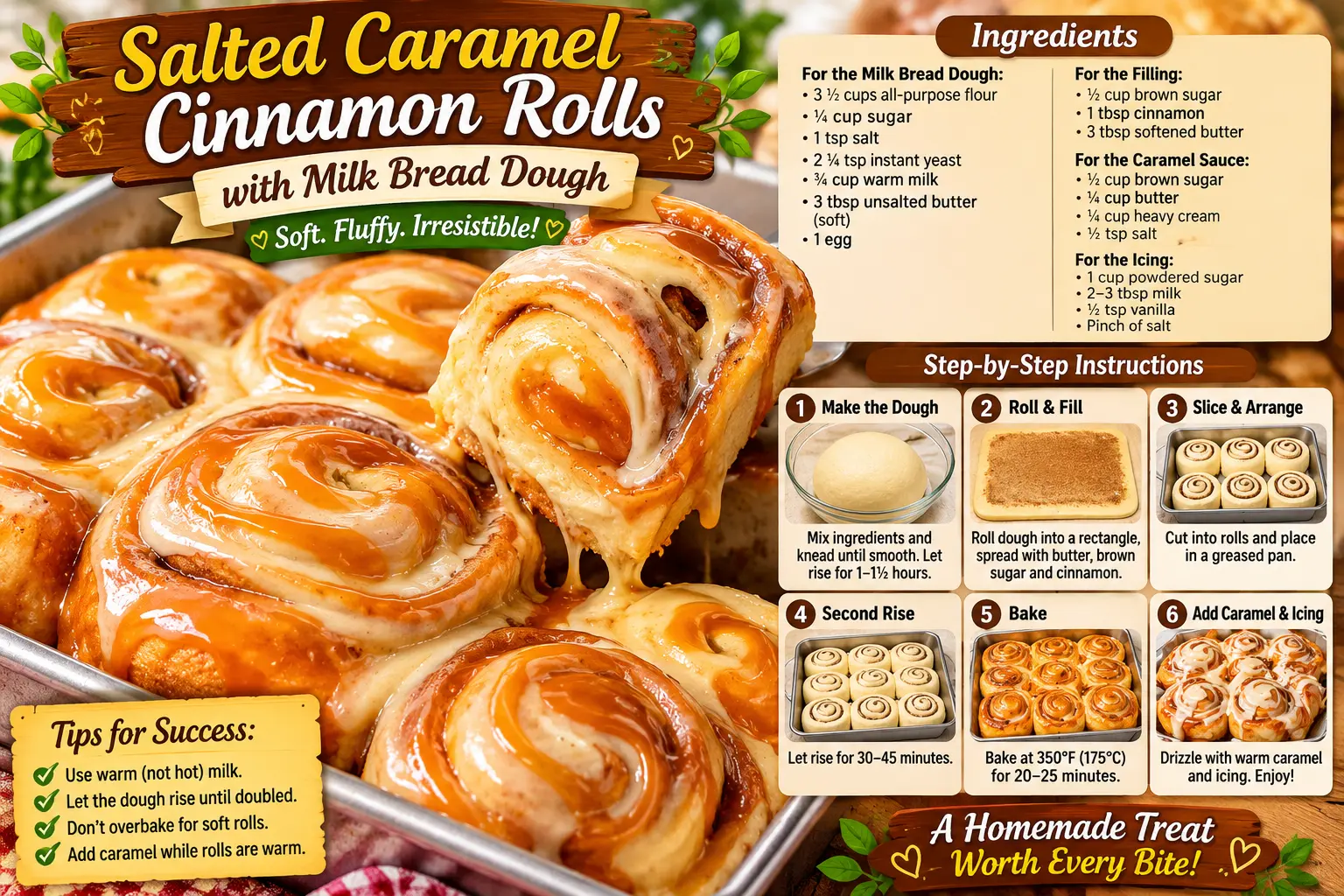
These salted caramel cinnamon rolls pair a soft milk-bread-style dough with brown sugar cinnamon filling and caramel cream cheese frosting. A small cooked flour-and-milk paste, called tangzhong, helps the dough hold moisture. This version uses ready-made caramel sauce, so there is no separate hot-sugar cooking step.
At a glance: 12 rolls · 9-by-13-inch metal pan · about 35 minutes prep, 40 minutes cooking, 2 1/2 hours rising, and 15 minutes cooling. Allow roughly 4 hours overall; proofing can take longer in a cool kitchen.
What the milk-bread method does
Tangzhong starts with a small measured portion of the recipe’s flour cooked in milk. The finished paste goes into the dough. It is a dough ingredient, not a sauce poured over the rolls. Keep the starter quantities separate from the remaining flour and milk so nothing is counted twice.
The reference image is watermarked Cambrea Bakes. Its original Salted Caramel Milk Bread Cinnamon Rolls uses a different formula and homemade caramel. The recipe below is an independently written, untested variation with store-bought caramel added after baking; it is not a transcription of that recipe or a promise of identical results.
Choose the ingredients before you start
- Bread flour: Weigh it for this dough. The recipe uses 500 g total: 25 g in the starter and 475 g in the main dough. Adding extra flour automatically can make the rolls heavier.
- Whole milk: The total is 300 g, split between starter and dough. The main-dough milk and cooked paste should not be hot when they meet the yeast.
- Instant yeast: This version is written for instant yeast. Different yeast types can require different handling and timing.
- Softened butter: It should spread easily but not be melted. This applies to the dough, filling, and frosting butter.
- Caramel sauce: Choose a thick, spoonable salted caramel sauce rather than a thin coffee syrup or hard candy. The whole 1/2 cup is divided between frosting and topping. Follow the jar’s storage directions after opening.
- Block cream cheese: A whipped spread may loosen the frosting. Keep it refrigerated except for brief softening and mixing.
Read the dough, not just the timer
The kneaded dough should feel soft and slightly tacky. Use a scraper and a light dusting of flour for handling; a dough that sticks a little is not automatically too wet. It should also stretch without breaking immediately. If it tears at once, give it a short rest and knead a little more before deciding it needs flour.
Allow both rises to show visible growth. During the final proof, neighboring rolls should move closer together and the dough should look fuller. Underproofed rolls can be dense even when their tops brown. Proofing longer is not always better, either: an overexpanded, fragile dough can collapse.
Keep the swirl neat
Spread the filling as a thin, even layer and roll from the long edge. Cut the 18-inch log into twelve equal pieces without pressing it flat. The caramel goes on after baking in this variation, which keeps a runny sauce out of the shaping step.
Make-ahead and storage
Prepare components ahead: Measure the dry ingredients and mix the cinnamon filling in advance. Refrigerate the filling and let it soften enough to spread before using. Keep the frosting ingredients cold until you need them.
Overnight option: After shaping, cover the pan and refrigerate at 40°F (4°C) or below for up to about 12 hours, before the second room-temperature rise. The next day, allow time for the rolls to become puffy before baking; chilled dough may need considerably longer than the same-day proof. This scheduling option has not been tested with this formula.
Frosted leftovers: Treat this cream cheese frosting as perishable. Refrigerate covered rolls within 2 hours, or within 1 hour above 90°F (32°C), and keep at 40°F (4°C) or below. For a conservative home-use target, use within 3–4 days. Sugar and caramel do not establish that this frosting is shelf-stable.
Serving later: Refrigerated rolls can be eaten chilled. If reheating leftovers, heat to 165°F (74°C); the frosting will melt. For better presentation, store frosting separately and add it after reheating the roll.
Frequently asked questions
Is tangzhong the same as a sourdough starter?
No. This is a briefly cooked flour-and-milk paste. It contains no fermented starter culture, and the dough still needs the listed yeast.
Can I add caramel inside the filling?
Not without changing this formulation. Sauce thickness varies, and extra liquid can make shaping and baking less predictable. This version keeps the caramel in the frosting and final drizzle.
Can I replace bread flour with gluten-free flour?
Not as a direct swap. Gluten-free dough needs a separately developed formula and method. These rolls contain wheat, milk, and egg.
Why are the rolls brown on top but doughy inside?
A dark pan, uneven oven heat, thick shaping, or insufficient baking can contribute. Protect the top loosely with foil and check the bread in a center roll rather than judging only the edges.
Do they need extra cream poured over them?
No extra cream is included in this recipe. Adding it would change the moisture balance and baking time.
More baking and reference notes
Browse our Desserts & Baking collection or Breakfast & Brunch for more ideas.
For background on the cooked-flour technique, see King Arthur Baking’s tangzhong explanation. For handling, review the FDA’s flour-safety advice. Do not taste raw dough. Frosting storage depends on its actual formulation; University of Minnesota Extension explains why sugar alone does not settle that question.
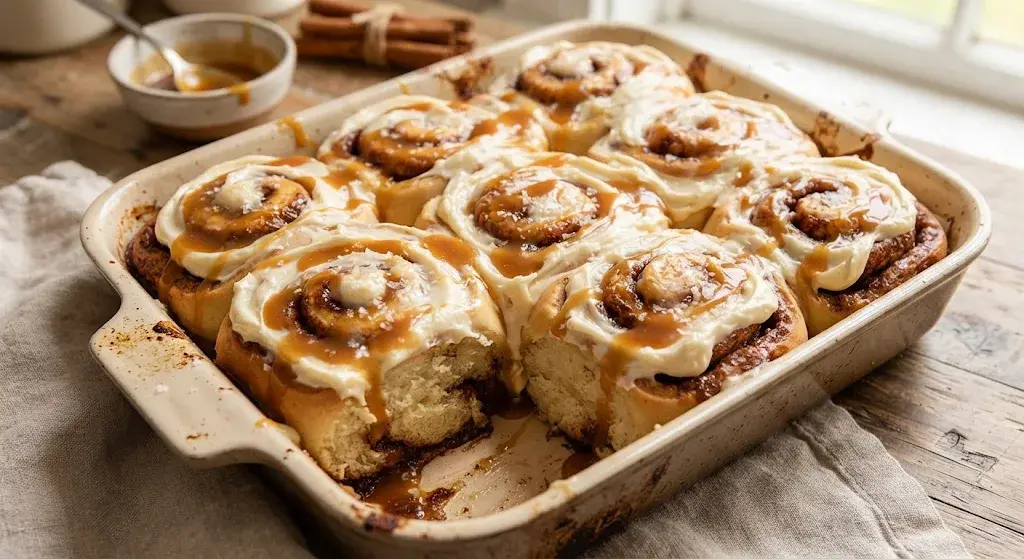
RECIPE CARD
Salted Caramel Cinnamon Rolls with Milk Bread Dough
Soft yeast rolls with a cinnamon-brown sugar swirl, caramel cream cheese frosting, and a salted caramel drizzle. Proposed home variation; not kitchen-tested.
Yield: 12 rolls.
Prep: 35 minutes.
Cook: 40 minutes, including about 5 minutes for tangzhong and 35 minutes baking.
Additional: about 150 minutes rising plus 15 minutes cooling.
Total: about 4 hours. All times are estimates.
Equipment
Kitchen scale, small saucepan, whisk, stand mixer with dough hook, mixing bowl, rolling pin, ruler, knife or unflavored floss, 9-by-13-inch metal pan, parchment, and a food thermometer.
Tangzhong
- 25 g bread flour
- 125 g whole milk
Main dough
- 475 g bread flour, plus a little for the work surface
- 175 g whole milk, lukewarm, not hot
- 60 g granulated sugar
- 7 g instant yeast (one standard 1/4-ounce packet)
- 8 g fine salt
- 1 large egg
- 75 g unsalted butter, softened
- All of the cooled tangzhong from above
Cinnamon filling
- 60 g unsalted butter, softened
- 140 g packed light brown sugar
- 1 tablespoon ground cinnamon
Frosting and caramel finish
- 115 g full-fat block cream cheese, softened briefly for mixing
- 30 g unsalted butter, softened
- 120 g powdered sugar, sifted if lumpy
- 1 teaspoon vanilla extract
- 1/2 cup thick store-bought salted caramel sauce, divided: 2 tablespoons for the frosting and the remaining 6 tablespoons for topping
- Optional: a small pinch of flaky salt, only if needed after tasting the caramel
Instructions
- Cook the tangzhong. Whisk the 25 g flour and 125 g milk in a small saucepan until smooth. Cook over medium-low heat, stirring, until it becomes a thick paste and a spoon leaves a clear track, roughly 3–5 minutes. Scrape into the mixer bowl and let cool until only slightly warm. Do not add yeast to a hot paste.
- Mix and knead. Add the 175 g lukewarm milk, egg, sugar, yeast, remaining 475 g flour, and salt. Mix with a dough hook on low until combined. Add the softened butter in several small pieces, letting each mix in. Knead on low to medium-low for about 8–12 minutes, following your mixer’s dough limits, until smooth and elastic. The dough should be slightly tacky but able to stretch thinly without immediately tearing. Do not add large amounts of extra flour to make it dry.
- Let the dough rise. Place in a lightly greased bowl, cover, and leave in a comfortably warm, draft-free place until roughly doubled, about 60–90 minutes. A cool room may take longer; use the dough’s expansion rather than a fixed deadline.
- Prepare the filling and pan. Mix the filling butter, brown sugar, and cinnamon into a spreadable paste. Grease a 9-by-13-inch metal baking pan or line it with parchment. Roll the dough on a lightly floured surface into an approximately 18-by-12-inch rectangle, with a long side facing you.
- Roll and cut. Spread the cinnamon filling over the rectangle, leaving about 1/2 inch bare along the far long edge. Roll from the long edge nearest you to form an 18-inch log. Cut into 12 pieces, about 1 1/2 inches thick, using a sharp serrated knife or plain, unflavored dental floss. Arrange cut-side up in 3 rows of 4.
- Proof again. Cover and let rise until the rolls are visibly expanded, airy, and nearly touching, roughly 45–75 minutes. Near the end, heat the oven to 350°F (175°C), conventional setting. Remove any plastic covering before baking.
- Bake through the center. Bake on the middle rack for about 25–35 minutes, or longer as needed, until lightly golden and the dough in a center roll reaches about 190°F (88°C). Measure in the bread, not a pocket of filling. If the tops darken early, cover loosely with foil and continue baking. Let stand about 15 minutes before frosting.
- Frost and finish. Beat the cream cheese and frosting butter until smooth, then beat in powdered sugar and vanilla. Mix in 2 tablespoons of the caramel. Spread over the warm, not piping-hot rolls and drizzle with the remaining 6 tablespoons caramel. Add a few salt flakes only if needed. Serve, then refrigerate leftovers promptly.
Notes
- Do not double-count: Total flour is 500 g and total milk is 300 g, split between tangzhong and main dough. All 1/2 cup caramel is used after baking.
- Timing: Dough temperature, room temperature, flour, and mixer performance change the schedule. Follow expansion and doneness cues.
- Food handling: Do not eat raw dough. Keep flour and raw-egg tools away from finished rolls and frosting. Refrigerate frosted leftovers promptly.
- Allergens: Contains wheat, milk, and egg. Check the caramel and other packaged ingredients for additional allergens.
- Nutrition: No nutrition values or ratings have been calculated or invented.